
articles
The Ghost on the Edge of the Rainbow
Violet sits at the edge of human vision, beyond the limits of most screens, and deep inside the cultural history of power, ritual, and imagination.
Violet is not just a colour. It is a threshold - between visible and invisible, physics and perception, nature and culture.
A · The edge of sight
Violet sits at the shortest-wavelength edge of human vision.
Beyond violet lies ultraviolet - physically present, but invisible to us.
B · Mediation
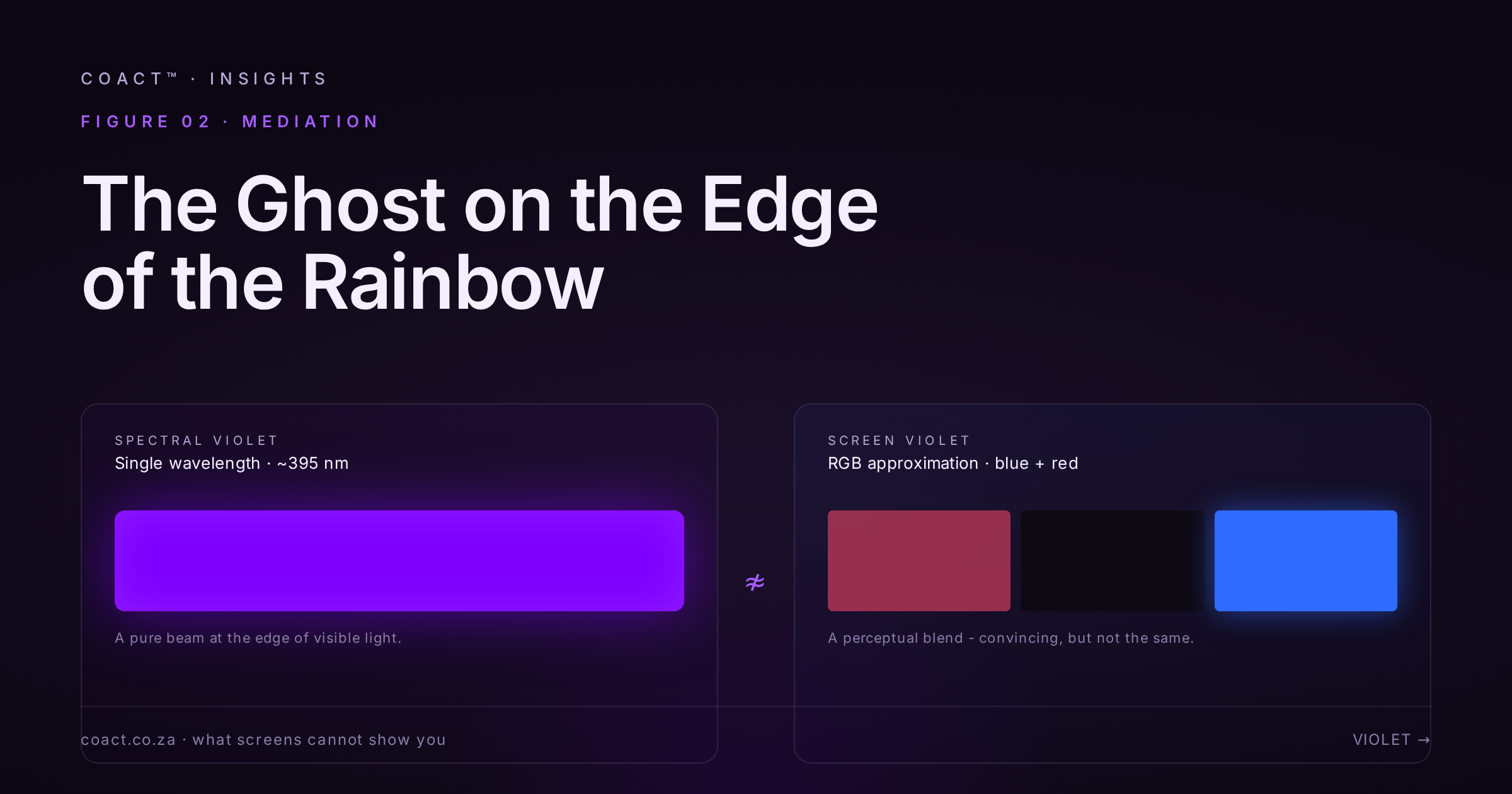
Why screens can't show true spectral violet.
Spectral violet
Single wavelength · ~395 nm
A pure beam at the edge of visible light. The thing screens cannot directly emit.
Screen violet
RGB approximation · blue + red
Most displays create violet as a perceptual blend - convincing, but not the same as a single-wavelength beam.
C · Inheritance
Violet in nature and in culture.
Because violet sits at the edge of sight, and because violet pigments were historically rare, the colour accumulated meanings tied to power, ritual, mystery, grief, and imagination.
Violet is not just a colour. It is a threshold - between visible and invisible, physics and perception, nature and culture.
There is something strange about violet.
It is one of the most emotionally loaded colours in human culture - tied to royalty, spirituality, mourning, ceremony, rebellion, imagination, and the sacred. It appears in flowers, fashion, stained glass, album covers, wellness brands, digital interfaces, and cosmic artwork. It feels ancient and futuristic at the same time.
And yet most people have never been told the strangest part: the violet they see on a screen is usually not true violet at all.
That sounds like a technicality. It isn't. It reveals something larger about how we experience reality: not directly, but through systems of perception, approximation, and meaning.
Violet sits at the far edge of human sight. It lives at the boundary where visible light ends and ultraviolet begins. It is a colour, yes - but it is also a threshold. And once you understand that, it becomes easier to see why violet has accumulated so much symbolic weight across science, art, religion, and culture.
1) Violet lives at the edge of what humans can see
Human eyes only detect a narrow slice of the electromagnetic spectrum. Within that small band, red occupies the longer-wavelength end, while violet sits at the shortest-wavelength edge of visible light - around 380 to 400 nanometres.
Past that point, light doesn't stop existing. It simply passes beyond our visual range into ultraviolet.
That gives violet an unusual status. It is not just another colour in the rainbow. It marks a limit condition: the place where our sight begins to fail and another part of reality continues without us.
In practical terms, violet is the borderline colour of human vision. It is the last visible signal before the world disappears into wavelengths we can no longer perceive.
That alone helps explain its cultural pull. Humans have always attached meaning to thresholds - dawn and dusk, shorelines, veils, doors, initiations, endings, and states in-between. Violet belongs to that family. It is a colour that already feels liminal before culture does anything with it.
2) Your screen can show purple. It usually cannot show true spectral violet.
This is where the science gets even more interesting.
Phones, laptops, TVs, and monitors do not produce colour the way sunlight through a prism does. Most digital displays use RGB light - red, green, and blue subpixels - and create colour by mixing those three light sources at different intensities.
That system is powerful, but it has limits.
A screen does not emit every visible wavelength directly. It works inside a colour gamut: a bounded range of colours it can approximate. When a display wants to show "violet," it generally cannot emit a pure single-wavelength beam at the spectral edge of human vision. Instead, it creates a proxy by combining intense blue with some red.
The result looks vivid and convincing. Your brain accepts it as violet-like. But physically, it is not the same thing as a narrow band of spectral violet at the edge of a prism.
In other words, one of the most symbolically loaded colours in human culture is also one of the clearest examples of how technology often gives us a persuasive reconstruction rather than a direct reproduction.
What we experience as "violet" on a screen is usually a carefully designed approximation. That doesn't make it fake in the casual sense. It makes it revealing.
Because it shows how often human experience depends on mediation:
- what our biology can detect
- what our tools can reproduce
- what our language groups together
- what our culture teaches us to notice
3) Violet is where physics and biology start negotiating
Part of violet's strangeness comes from the fact that it sits right where light physics and human perception begin to diverge.
Light itself is continuous. It exists as wavelengths across a broad spectrum. But human colour perception is not a simple meter reading of wavelength. It is a biological interpretation system built from cone cells in the eye and processing in the brain.
So violet is not just "out there" in the world. It is also something our nervous system has to construct from what it can detect at the edge of its limits.
That means violet already carries a kind of instability before culture even touches it:
- physically, it is near the border of visibility
- biologically, it is near the edge of our perceptual capacity
- digitally, it is often simulated rather than reproduced directly
It is a colour with built-in ambiguity. And that ambiguity may be part of why it has never stayed confined to decoration. Violet keeps getting recruited into meaning.
4) Culture turned violet into a signal of rarity, power, and altered states
Long before screens, violet and purple tones were already culturally charged because they were difficult to produce and expensive to own.
In the ancient Mediterranean world, Tyrian purple dye became associated with imperial wealth because it was laborious to extract and prohibitively costly. In later contexts, violet and purple shades appeared in liturgical garments, ceremonial robes, aristocratic dress, and sacred art. Scarcity gave the colour social gravity. Difficulty became prestige. Rarity became symbolism.
Over time, those meanings expanded. Violet came to signify:
- royalty and sovereignty
- spirituality and ritual
- mystery, introspection, and the unseen
- grief, transition, and remembrance
- creativity, imagination, and altered consciousness
- nonconformity, counterculture, and aesthetic rebellion
That range is not random. Violet is one of the few colours whose physical position at a threshold maps unusually well onto the kinds of symbolic roles cultures repeatedly give it. It sits between visibility and invisibility, so we use it to talk about things that also sit between worlds: sacred and secular, body and spirit, order and imagination, power and secrecy, grief and transformation.
In that sense, violet is not just culturally meaningful because people arbitrarily decided it was. It is meaningful because material rarity, perceptual liminality, and historical repetition reinforced each other over time.
5) Violet shows how meaning is built
This is the part that matters most to COACT™.
Violet is a reminder that human systems rarely emerge from one layer alone. Meaning forms when multiple layers interact:
- physics gives us the wavelength
- biology gives us the perceptual limit
- technology gives us approximations and proxies
- economics determines who can access pigments, dyes, and symbols
- culture accumulates associations and rituals
- design stabilises those meanings into repeatable forms
By the time we encounter violet in a brand, a garment, a cathedral window, or a digital interface, we are not encountering "just a colour." We are encountering a stack of systems: natural, perceptual, historical, technical, and symbolic.
That is part of why violet feels so dense. It carries more than hue. It carries inheritance.
And once you notice that, violet becomes a useful example of a larger truth: the things we experience most casually are often the result of multiple hidden systems interacting underneath the surface.
6) Why violet still matters now
In a world increasingly mediated by screens, synthetic images, and interface-level experiences, violet becomes even more interesting.
It is a colour that exposes the gap between what is shown and what is physically present. It reminds us that perception is often assembled from partial access. It shows us how quickly a good proxy can become culturally normalised as "the real thing."
That does not make the proxy useless. Digital violet is still beautiful. Symbolic violet is still meaningful. Cultural violet is still powerful.
But it does remind us to look twice at anything that feels obvious. Because often what seems direct is actually layered: sensed through biology, rendered through technology, inherited through culture, repeated through design, and mistaken for nature once it becomes familiar enough.
Violet makes that construction visible.
Closing
Violet is easy to treat as decorative. A mood. A brand choice. A floral detail. A spiritual cliché.
But it is more than that.
It is the last visible note before the spectrum falls silent to human eyes. It is a colour our screens imitate rather than fully reproduce. It is a pigment shaped by scarcity and status. It is a symbol built from centuries of ritual, power, grief, imagination, and desire.
In other words, violet is not just a colour. It is a convergence point.
A place where science, perception, technology, and culture all meet - and where the edges between them become visible for a moment.
That may be why it continues to haunt us. Not because it is rare in the world. But because it reminds us how much of the world we only ever encounter through the filters that make it legible.
Continue reading
If this resonated, share it with a founder who needs better infrastructure - not more pressure.