
articles
The Missing Infrastructure of Entrepreneurship
How walking through the Valley of Death led to the creation of VentureOS. After more than a decade alongside founders, COACT™ founder Daniel de Bruin concluded the bottleneck is not founders - it is the absence of coherent venture infrastructure.
How Walking Through the Valley of Death Led to the Creation of VentureOS
Most conversations about entrepreneurship focus on founders.
How do we make founders more resilient?
How do we help them move faster?
How do we teach them to pitch better, sell better, scale better, and lead better?
These are important questions.
But after more than a decade spent working alongside entrepreneurs, venture teams, ecosystem partners, and innovation communities, we have come to believe there is a more fundamental question that receives far less attention.
What if founders are not the primary problem?
What if the real problem is the absence of venture infrastructure?
This question sits at the heart of why COACT™ exists.
And it is the question that ultimately led our founder, Daniel de Bruin, to begin developing what would become VentureOS.
The Pattern We Could Not Ignore
Long before there was a VentureOS, a Venture Constitution, or a Violet Culture, there was a recurring frustration.
Across industries, sectors, and stages of growth, the same pattern kept emerging.
Talented people with meaningful ideas were struggling to turn potential into sustainable ventures.
Some lacked funding.
Some lacked market fit.
Some lacked execution.
But many appeared to have all the ingredients conventional startup thinking says should lead to success.
And yet they still failed.
Not always dramatically.
Often quietly.
A venture stalled.
A founder burned out.
A partnership broke down.
An opportunity was missed.
Momentum disappeared.
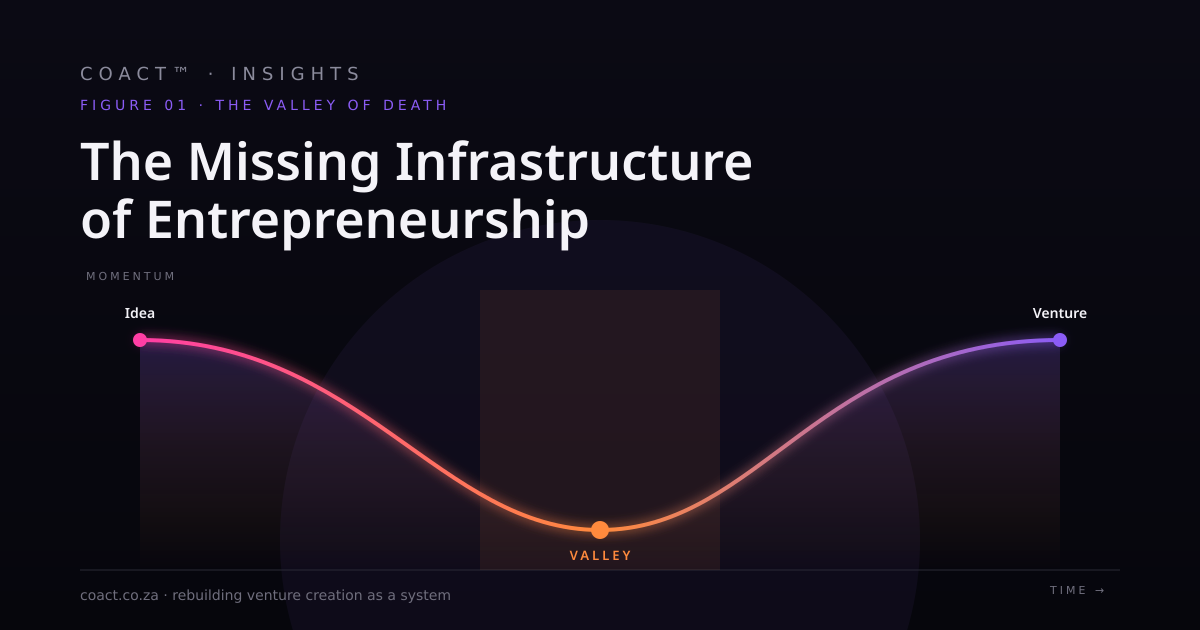
Most ventures collapse in the middle - not from a lack of effort, but from a lack of infrastructure to sequence decisions, preserve context and absorb complexity. VentureOS is designed to flatten this curve.
Over time, Daniel became increasingly uncomfortable with the explanations being offered.
The entrepreneurial world seemed obsessed with products, capital, growth hacks, accelerators, and tactics.
Yet very little attention was being paid to the underlying infrastructure required to build a venture.
Founders were expected to navigate strategy, governance, intellectual property, technology, operations, partnerships, customer development, compliance, capital, culture, and leadership - often while learning each discipline for the first time.
The more we observed, the clearer it became.
Many founders were not failing because they lacked capability.
They were falling through the cracks of a fragmented system.
What many refer to as the Valley of Death was often not a failure of founders.
It was a failure of infrastructure.
A Different Question
Once you begin to see the problem differently, you start looking for answers in different places.
Rather than asking how founders could work harder, move faster, or absorb more complexity, Daniel began exploring a different question:
What would venture creation look like if it were designed as a system?
Not a collection of tools.
Not a methodology.
Not another accelerator programme.
A system.
One capable of supporting founders through uncertainty while preserving clarity, coherence, and human agency.
Finding that answer required looking far beyond traditional entrepreneurship.
Understanding the Human Side of Venture Building
One of the strongest influences on our thinking came from psychology, behavioural science, and years of coaching founders through uncertainty.
Entrepreneurship is often described as a commercial challenge.
In reality, it is also a profoundly human one.
Founders carry enormous cognitive and emotional loads.
They make decisions with incomplete information.
They navigate ambiguity daily.
They absorb risk, pressure, responsibility, and often isolation.
Yet many entrepreneurial systems are designed as though human beings have unlimited capacity.
Experience taught us otherwise.
Decision fatigue is real.
Burnout is real.
Overwhelm is real.
The loss of confidence that accompanies prolonged uncertainty is real.
These are not individual shortcomings.
They are predictable conditions that emerge when complexity exceeds a person's ability to manage it.
This insight became foundational.
The goal was not simply to help founders work harder.
The goal was to design systems that help founders think more clearly.
Learning from Nature
As the search continued, another influence emerged: biomimicry.
Nature has spent billions of years solving problems of adaptation, resilience, and survival.
Healthy ecosystems do not thrive through relentless extraction.
They thrive through balance.
Through feedback.
Through interdependence.
Through regeneration.
This perspective fundamentally shifted how we viewed ventures.
A venture is not a machine.
It is a living system.
It has relationships, dependencies, feedback loops, resource constraints, and stages of development.
Like any living system, it can be nurtured or depleted.
Strengthened or weakened.
Designed for resilience or designed for collapse.
This became one of the reasons stewardship emerged as such a central principle in our work.
An African Perspective on Enterprise
Being built from South Africa also shaped the evolution of our thinking.
Many of the dominant models of entrepreneurship originate from ecosystems that prioritise competition, acceleration, and individual achievement.
While these models have generated remarkable innovation, they are not the only lens through which enterprise can be understood.
Ubuntu offers another.
Often translated as:
I am because we are.
Ubuntu reminds us that people do not flourish in isolation.
Neither do ventures.
Every successful enterprise depends on relationships, trust, communities, customers, collaborators, and ecosystems.
This understanding reinforced something we were already observing.
Value creation is not merely an individual act.
It is a collective one.
And ventures become stronger when they recognise and steward the systems that make their existence possible.
From Ownership to Stewardship
Over time, another distinction became impossible to ignore.
Many organisations are built around ownership.
Control.
Authority.
Extraction.
Yet the ventures that endured often operated from a different mindset.
They behaved as stewards.
Stewards of capital.
Stewards of intellectual property.
Stewards of people.
Stewards of trust.
Stewards of future opportunity.
This idea resonated deeply with constitutional thinking and the concept of fiduciary responsibility.
Leadership, in this context, is not about possessing something.
It is about caring for something entrusted to you.
This insight eventually evolved into what we now call Constitutional Venture Stewardship.
A venture is not merely an asset to be exploited.
It is a system to be developed responsibly across time.
Technology as Amplification
As advances in artificial intelligence accelerated, another question emerged.
What role should technology play in venture creation?
Much of the industry focused on automation and replacement.
Our interest was elsewhere.
We were drawn to an older idea - one explored by pioneers of cybernetics and computing who believed technology should amplify human capability rather than replace it.
The challenge founders face is rarely a lack of intelligence.
More often, it is the challenge of managing complexity.
Too many decisions.
Too many moving parts.
Too much context to hold at once.
This led us toward a simple principle:
Technology should strengthen human judgment, not substitute for it.
Its role is to help preserve context, support sequencing, maintain continuity, and reduce unnecessary cognitive burden.
The human remains responsible for judgment, ethics, creativity, relationships, and stewardship.
The system exists to help them do that more effectively.
From Extraction to Creation
Underlying all these influences was a deeper philosophical shift.
Many modern systems are built around extraction.
Extract more value.
Extract more growth.
Extract more effort.
Extract more attention.
But meaningful ventures are not extracted into existence.
They are created.
Cultivated.
Developed.
Stewarded.
This idea found expression in what eventually became Violet Culture.
An alternative to hustle culture.
An alternative to burnout as a business strategy.
An alternative to the belief that speed alone creates value.
Violet Culture emerged from a simple conviction:
Sustainable ventures require sustainable builders.
Clarity matters.
Coherence matters.
Human wellbeing matters.
And the way we build is just as important as what we build.
Building What Was Missing
Years of observation.
Years of experimentation.
Years of learning from founders, ventures, ecosystems, successes, failures, and hard-earned experience.
Gradually, the pieces began to connect.
Psychology helped us understand people.
Biomimicry helped us understand living systems.
Ubuntu reminded us that value creation is relational.
Constitutional stewardship provided a governance philosophy.
Augmented intelligence offered a way to navigate complexity without sacrificing human agency.
Together, they formed the foundations of VentureOS.
Not as a product.
Not as a programme.
But as an operating system for venture creation.
An attempt to build the infrastructure we repeatedly found was missing.
Why This Matters
The future of entrepreneurship will not be shaped solely by better founders.
It will be shaped by better systems.
For too long, the burden of venture creation has been placed almost entirely on the individual.
Work harder.
Move faster.
Push further.
Carry more.
But perhaps the better question is this:
Why are founders carrying so much alone in the first place?
At COACT, we believe entrepreneurship deserves better infrastructure.
Infrastructure that preserves human dignity.
Infrastructure that supports better decisions.
Infrastructure that helps founders navigate complexity without becoming consumed by it.
Infrastructure designed around stewardship rather than extraction.
That belief is what led Daniel de Bruin to begin building VentureOS.
And it remains the work we continue to advance today.
Because when people are supported by coherent systems, extraordinary things become possible.
About COACT
COACT is a venture architecture ecosystem dedicated to helping founders transform ideas into sustainable, stewarded enterprises through VentureOS, Violet Culture (VIAI Violet | Augmented Intelligence), and Constitutional (Venture) Stewardship. Built at the intersection of systems thinking, augmented intelligence, psychology, and human-centred design, COACT exists to provide the infrastructure entrepreneurs need to create enduring value in an increasingly complex world.
Because the future doesn't need founders who can carry more.
It needs systems that help them carry less.
Continue reading
If this resonated, share it with a founder who needs better infrastructure - not more pressure.